

 English
 Spanish
 French
 German
 Italian
 Chinese (Simplified)
 Japanese
 Korean
 Arabic
 Portuguese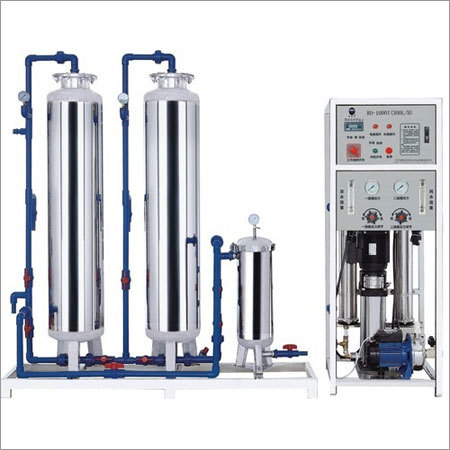
Demineralization Water Plants
300000.00 - 2500000.00 INR/Unit
Product Details:
- Feature Corrosion Resistant, High Efficiency, Low Maintenance
- Noise Level Low
- Usage & Applications Hospital, Industrial, Boiler Feed, Laboratories, Electronics
- Recycle Rate Up to 98%
- Water Out Conductivity 1 S/cm
- Water in conductivity Variable, depending on feed source
- Pump Type Centrifugal / Dosing pump
- Click to View more
X
Demineralization Water Plants Price And Quantity
- 300000.00 - 2500000.00 INR/Unit
- 1 Unit
Demineralization Water Plants Product Specifications
- Skid mounted / On-site installation
- Ion Exchange
- Multi Grade Sand Filter, Activated Carbon Filter
- Variable as per model/specification
- 6.5 - 7.5
- 250 LPH to 10000 LPH
- 50/60 Hz
- 99%
- Borewell, Municipal, Industrial Water
- 2-5 kW (may vary with capacity)
- Electric
- Variable, depending on feed source
- Centrifugal / Dosing pump
- 1 S/cm
- Electric Motor
- Up to 99%
- Semi-Automatic / Automatic
- FRP / Stainless Steel
- Up to 98%
- 220-380V (as per model)
- Customizable
- Demineralization Water Plant
- Corrosion Resistant, High Efficiency, Low Maintenance
- Hospital, Industrial, Boiler Feed, Laboratories, Electronics
- Low
- 2-4 kg/cm2
- ISI / CE Certified
- 8-10 years (with proper maintenance)
- Up to 500 ppm
- Strong Acid Cation and Strong Base Anion Resin
- 5C - 50C
- Modular & Compact
- Chemical Dosing (Acid/Alkali)
- Yes, for specific feed waters
- PLC/Manual
- 1 - 2 inch
Demineralization Water Plants Trade Information
- 20 Unit Per Week
- 10 Days
Product Description
Due to our huge experience in this field, we offer top grade DM Water Plants. Provide plant is mainly used for treating water by removing impurities and salt from it. Offered in various capacities, they are manufactured & assembled in accordance with set industry norms using quality-tested components. These plants are widely used in Hospitals, hotels, laundries & air-conditioning plants for water purification. In addition to this, our valuable customers can avail these DM Water Plants from us at reasonable rates within prescribed time frame in bulk.
Application Area:
Application Area:
- Hospitals, hotels, laundries & air-conditioning plants
- Beverage production
- Textile processing
- Cooling water make up
- Power Supply: AC380 50Hz 3phase
- Feed Water TDS: <=10000mg/L
- Pumps: Nanfang Cnp or Grundfos
Technical Specification
| Power Supply | 50Hz 3 Phase |
| Pumps | Nanfang Cnp or Grundfos |
| System Recovery Rate | More Than 60% |
| Voltage | 380 VAC |
| Brand | Accurate |
| Flow Rate | 5000 m3/hour |
| Water Source | Industrial Effluent |
| Usage/Application | Industrial |
Advanced Ion Exchange Technology
Utilizing strong acid cation and strong base anion resin, these plants deliver consistently high-quality demineralized water. The systems modular, compact design supports space-saving installation and easy scalability. With a state-of-the-art control panel (PLC/manual), users benefit from both precise automation and manual operation, adaptable for diverse industrial needs.
Reliable Performance and Safety
Built with durable FRP or stainless steel, the plants withstand rigorous operating pressures (24 kg/cm) and wide temperature variations (5C50C). The chemical dosing regeneration process sustains resin efficiency over an impressive service life of 810 years. ISI/CE certifications affirm adherence to stringent performance and safety protocols.
Efficiency, Purity, and Versatility
Achieving up to 98% water recycle rate and 99% purity, these plants support eco-friendly, high-efficiency operations. Flow rates, pump types, and capacity are fully customizable, ensuring suitability for a range of applicationsfrom hospital and laboratory use to boiler feed and electronics manufacturing. Maintenance and power usage remain low, maximizing operational convenience.
FAQs of Demineralization Water Plants:
Q: How does the demineralization water plant achieve high purity levels?
A: The plant uses strong acid cation and strong base anion exchange resins to remove dissolved ionic impurities from water. Through a chemical dosing regeneration process involving acids and alkalis, the resins maintain their capacity, consistently producing water with up to 99% purity and a conductivity of no more than 1 S/cm.Q: What is the typical process flow in this demineralization system?
A: Feed water typically undergoes pre-treatment (such as sand or activated carbon filtration) if required, followed by ion exchange in the resin columns. The automatic or manual control panel manages process parameters and regeneration cycles. Clean, demineralized water is then delivered to the designated application point.Q: When should the resin be regenerated or replaced in this system?
A: Regeneration occurs when the resins reach their ion exchange capacity, which will be indicated by an increase in water conductivity above specification. Normally, the system is designed for resin regeneration using chemical dosing after each service cycle, ensuring a service life of 810 years with proper maintenance.Q: Where can these demineralization plants be installed?
A: The modular and compact design allows installation in a range of environmentsskid-mounted for easy relocation or onsite assembly. They are ideal for industrial plants, hospitals, laboratory facilities, or electronics manufacturing units, and compatible with water sources such as borewell, municipal, or industrial supply.Q: What are the primary benefits of choosing this demineralization water plant?
A: Key advantages include high water purity, chemically resistant construction, low operating and maintenance costs, and efficient recycling (up to 98%). The plants automation, flexibility in capacity, and compliance with ISI/CE standards further ensure user safety and operational reliability.Q: How much maintenance is required for optimal plant performance?
A: The system is designed for minimal maintenance, thanks to corrosion-resistant materials and efficient chemical regeneration. Routine checks on resin condition, control panels, and pumps are recommended to maximize service life and performance.Q: Can the demineralization plant handle varying inlet hardness?
A: Yes, the system accommodates feed water with hardness up to 500 ppm, ensuring consistent output quality even with varying input water sources. For specific ultrapure or challenging feeds, pre-treatment is recommended to maintain optimal resin and plant performance.Tell us about your requirement

Price:
Quantity
Select Unit
- 50
- 100
- 200
- 250
- 500
- 1000+
Additional detail
Mobile number
Email

Other Products in 'Demineralization Water Plant' category


SPARES INDIA WATER TECHNOLOGIST
GST : 24ADEPK6915F1ZR
GST : 24ADEPK6915F1ZR
Contact Us

- 119, Rajdeep Industrial Estate, Near Vatva Tolnaka, Vatva,Ahmedabad - 382440, Gujarat, India
- Phone :08045479347
|


- Mr Hitesh Ganpatlal Khambholja (Proprietor)
- Mobile :08045479347
- Send Inquiry
 Send Inquiry
 Send Inquiry
 Send SMS
SPARES INDIA WATER TECHNOLOGIST
All Rights Reserved.(Terms of Use)
Developed and Managed by Infocom Network Private Limited.
Developed and Managed by Infocom Network Private Limited.

